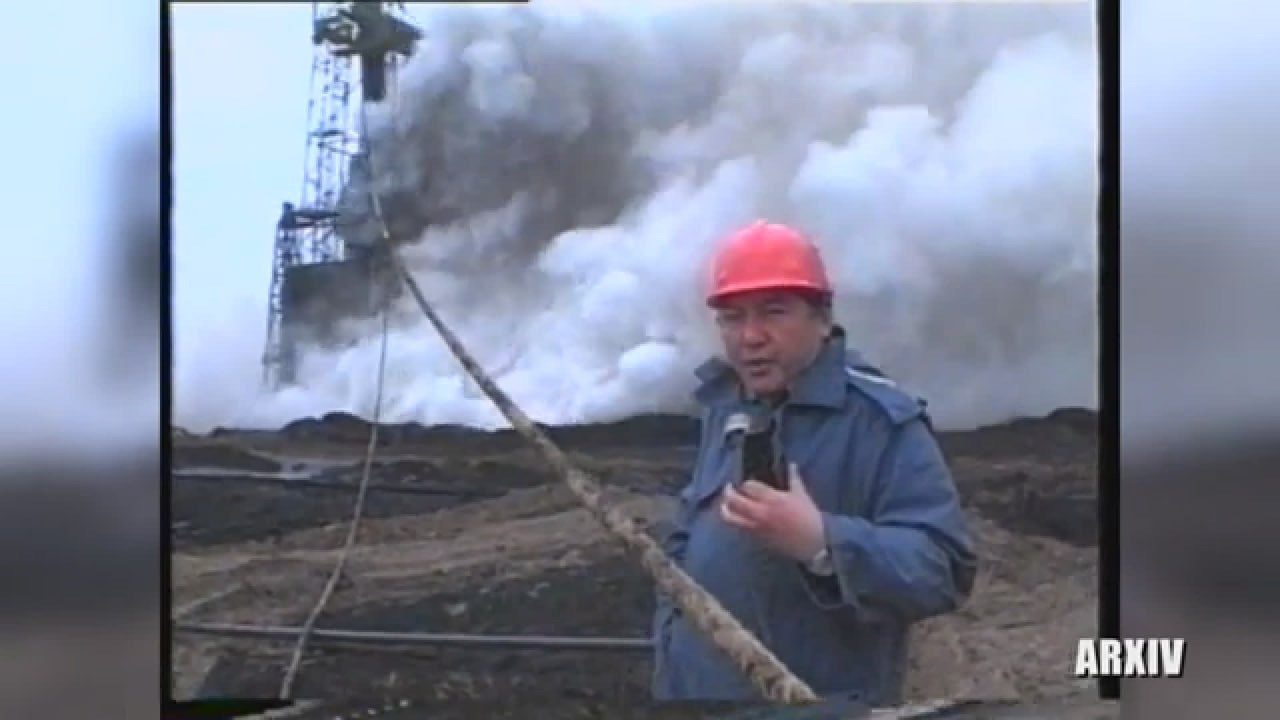
Muhammadjon Obidov
Honored Journalist of Uzbekistan
Mingbulak, 1992
This article is based on my personal memories, observations, and diary notes as a journalist who directly covered the events surrounding the Mingbulak oil blowout in 1992. Alongside historical facts, it reflects my personal impressions of the events, the people involved, the decision-making process, and the atmosphere of that period.
The year 1992 was an extremely difficult time for Uzbekistan economically, socially, and politically. Although the country’s independence was a historic and momentous achievement, the economic hardships of the early years prevented many people from fully appreciating its significance.
In 1991–1992, the system of economic cooperation that had existed within the former Soviet Union collapsed. Uzbekistan had primarily served as a supplier of agricultural raw materials, including cotton, fruits, and vegetables. According to the centralized planning system of the Soviet era, industrial goods, food products, and grain were supplied from Russia, Ukraine, and Kazakhstan. For decades, the republics had functioned under this arrangement.
Following the dissolution of the Soviet Union, severe shortages of essential goods emerged. Flour, cooking oil, soap, sugar, and other basic necessities were distributed according to fixed quotas. For example, each person was entitled to only 2 kilograms of flour, 800 grams of cottonseed oil, 200 grams of sugar, and one bar of laundry soap per month.
Uzbekistan’s industrial sector was deeply dependent on economic ties with Russia and other former Soviet republics. The country produced very few value-added or export-oriented products. Cotton fiber was sold through the Liverpool Cotton Exchange in the United Kingdom, while Uzbekistan lacked sufficient hard currency, foreign trade experience, and specialists capable of conducting business in international markets.
At the same time, the newly independent state faced enormous challenges. It had to establish its own Ministry of Defense, border troops, diplomatic missions abroad, and the institutions necessary for a sovereign state. All of this required substantial financial resources and foreign currency.
Against this backdrop, any positive development capable of strengthening the country’s economic independence was viewed as a major national event.
Such an event occurred on March 2, 1992, when a powerful oil blowout erupted at one of the drilling sites in the Mingbulak field in Namangan Region.
The oil fountain rose approximately 50–60 meters into the air. According to specialists, oil was erupting from a depth of about 5,500 meters under pressure reaching 1,000 atmospheres underground and nearly 700 atmospheres at the surface.
The news immediately attracted attention not only throughout Uzbekistan but around the world. Oil industry experts from Russia, the United States, and Azerbaijan noted that fewer than ten oil blowouts of such pressure had ever been recorded globally. If the well could be brought under control, the tens of thousands of tons of oil being released every day could generate enormous revenues for Uzbekistan.
On March 3, the first television report from the site was broadcast on the news program Akhborot. A wave of excitement swept across the country. Many people began saying, “Uzbekistan will become another Kuwait.”
However, beneath the optimism lay an extremely difficult reality.
The pressure of the blowout was extraordinarily high. While this indicated tremendous production potential, there was no blowout preventer capable of withstanding such pressure. Specialized equipment had to be urgently sourced from abroad.
Compounding the danger, the well was located only a short distance from the Syr Darya River. More than ten thousand tons of oil were erupting daily, creating a serious risk of environmental disaster if the oil reached the river.
The government commission therefore focused not on investigating the causes of the blowout but on bringing it under control. Emergency measures included constructing protective barriers, building railway infrastructure for transporting the oil, and mobilizing domestic and foreign specialists.
A tent city and mobile operations center were established near the site. As a correspondent for Akhborot, my cameraman and I lived there, documenting events around the clock and sending reports to Tashkent.
According to specialists, the accident resulted from a combination of factors. Geological conditions were more complex than anticipated, and the pressure characteristics of the deep reservoirs had not been fully understood. In addition, the blowout preventer designed to seal the well in an emergency failed under the extreme pressure. Organizational and planning shortcomings also contributed to the disaster.
As days passed, the situation worsened. Oil particles settled on nearby villages, darkened rooftops, damaged vegetation, contaminated the air, and caused significant environmental and economic harm.
On March 7, Uzbekistan’s first President, Islam Karimov, visited the disaster site. He personally reviewed the situation, met with oil workers, geologists, military personnel, and emergency officials, and ordered the mobilization of all available resources, including international expertise.
Specialists from the United States who had participated in extinguishing oil well fires in Kuwait were invited to Mingbulak. Unfortunately, despite extensive efforts by hundreds of experts, no effective solution could be found.
Attempts to control the blowout continued.
On April 2, 1992, a decision was made to pull down the drilling tower and then seal the well. When the structure collapsed, sparks ignited the escaping oil, instantly transforming the oil fountain into a massive column of fire reaching 40–50 meters into the sky.
Although the uncontrolled flow of oil around the site ceased, a new challenge emerged. Temperatures exceeded 1,500 degrees Celsius, causing even the strongest equipment and sealing devices to melt before they could be installed.
Additional high-strength blowout preventers and wellhead equipment were brought in, but repeated attempts to cap the well failed.
Then, on the night of May 2, 1992, something unexpected happened.
During a late-night meeting of specialists, a man rushed into the operations trailer shouting:
“The fire is dying down!”
Everyone rushed outside. Within minutes, the towering flame gradually shrank, sank to ground level, and disappeared.
The first person to move toward the well was Deputy Prime Minister Qayum Haqqulov. He stopped everyone and warned:
“Stay back! The fire could erupt again. I am responsible for your lives. No one goes forward. I will go alone.”
Yet no one remained behind. Everyone followed him.
After examining the site, specialists concluded that a collapse had occurred deep underground, blocking the pathway through which the oil and gas had been escaping.
The news had to be reported immediately to President Karimov.
Despite the late hour, Haqqulov insisted that the President be awakened. The news reportedly struck him like a bolt of lightning. After briefly ending the call, he telephoned again and asked the question that mattered most:
“Qayum, tell me, is there really oil in Mingbulak?”
Their conversation lasted more than thirty minutes.
Although the blowout was never brought under control by technical means, Uzbekistan’s oil and gas specialists demonstrated extraordinary professionalism, dedication, and courage. Engineers, geologists, drilling crews, government officials, and foreign experts worked around the clock under extremely difficult conditions.
Only hours after learning that the fire had gone out, President Karimov returned to Mingbulak.
The Mingbulak disaster became a turning point for Uzbekistan’s oil and gas sector. It demonstrated the importance of accurate geological research, reliable safety systems, and preparedness for emergencies. It showed how a single technical failure could produce consequences of national significance.
More than thirty-four years have passed since those events. As a television journalist and correspondent of Akhborot, who lived at the site for nearly two months and reported daily from the scene, I have shared the observations and conclusions recorded in my notebooks from that extraordinary time.
Many of the specialists, engineers, scientists, organizers, and officials who participated in those events are still alive today. Their memories, experiences, analyses, and lessons deserve a place in textbooks and in the history of Uzbekistan’s oil and gas industry.
The Mingbulak oil blowout is not merely an event of the past. It remains an enduring lesson about industrial safety, environmental responsibility, and the indispensable value of scientific knowledge and professional expertise.